
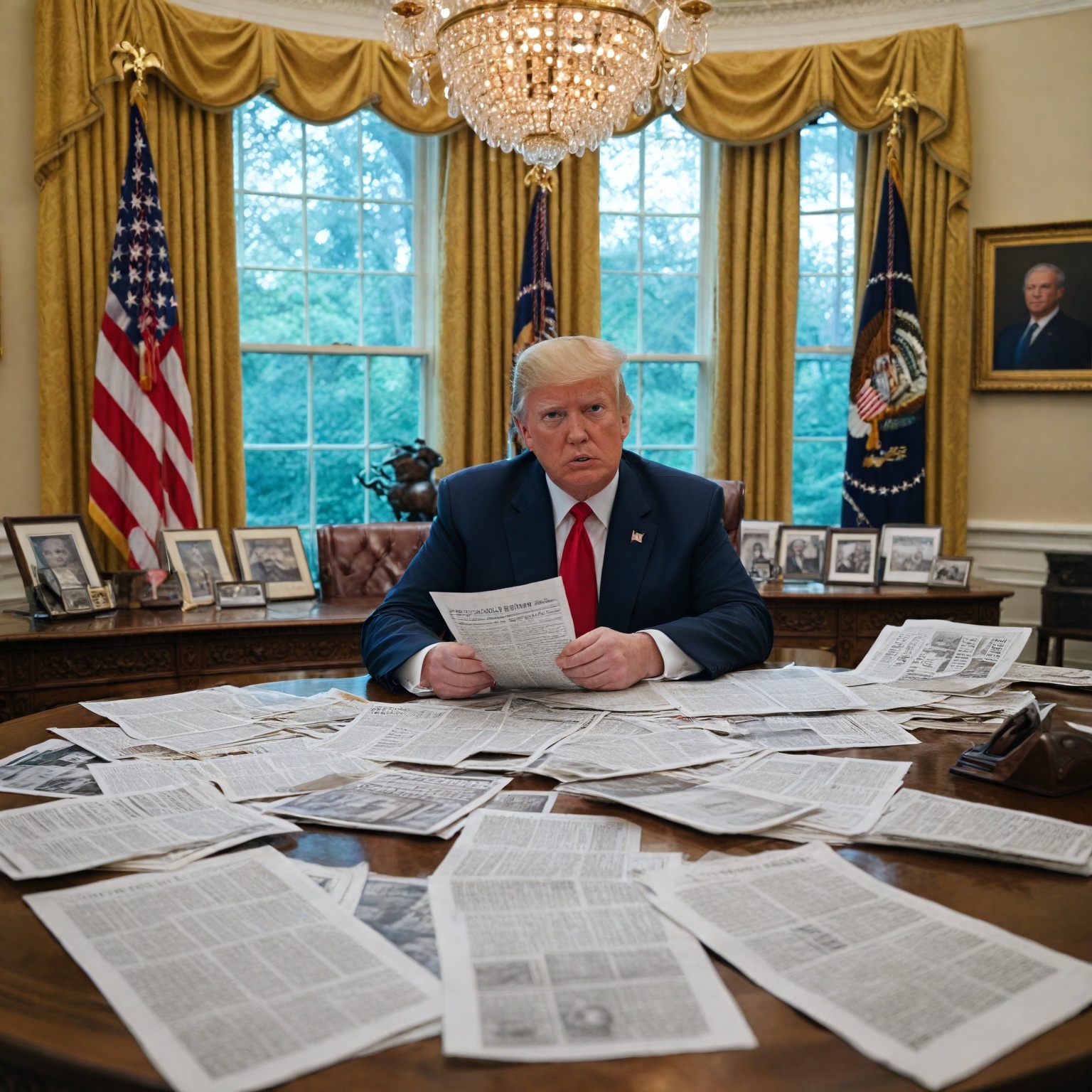
Highlights:
#Highlights:
– President Trump faced historical lows in approval ratings during his first 100 days due to dissatisfaction with economic policies, foreign policy, and immigration, prompting concerns about executive overreach.
– Partisan divisions significantly influenced approval trends, with solid Republican support contrasting starkly with Democratic disapproval, showcasing a deeply divided electorate.
– Analysts noted the potential political consequences of Trump's consistently low approval ratings, serving as a harbinger of challenges for his party in subsequent elections and potentially hampering legislative effectiveness.
Summary
President Donald Trump’s approval ratings experienced a notable decline as he approached his first 100 days in office, reflecting a polarized public response to his early presidency. Traditionally, the first 100 days of a U.S. presidency are seen as a critical period for establishing momentum and shaping public perception, with many presidents enjoying a “honeymoon” phase of relatively high approval. However, Trump’s approval ratings remained consistently low compared to historical standards, making him one of the least popular new presidents in recent decades.
Key factors contributing to the drop in Trump’s approval include widespread dissatisfaction with his economic policies, particularly the introduction of tariffs that many voters blamed for rising prices and inflation. Public confidence also waned regarding his handling of foreign policy and immigration, while his frequent use of executive orders sparked concerns about overreach. Despite these challenges, partisan divisions strongly influenced approval trends, with solid support among Republicans contrasting sharply with near-universal disapproval from Democrats and significant erosion among independents.
Polling data from multiple reputable sources consistently showed Trump’s approval hovering below 50%, a stark contrast to the typical early-term boost experienced by many presidents. Analysts highlighted the potential political ramifications of these ratings, noting that early declines often presage difficulties for a president’s party in subsequent elections and can limit legislative effectiveness.
The controversy surrounding Trump’s approval ratings underscores broader debates about his administration’s policy priorities and leadership style. While supporters praised his commitment to campaign promises, critics argued that his approach risked economic instability and overused executive power, contributing to a deeply divided national electorate. These dynamics positioned Trump’s first 100 days as a notably turbulent period in modern presidential history.
Background
Presidential approval ratings typically undergo significant changes during the first months of a new administration, with a more accurate measure of public sentiment often emerging by early September, several months after the initial 100-day period. Historically, presidents since the 1990s have experienced a decline in approval from their 100-day mark to that September, as seen with Bill Clinton and George W. Bush. This trend reflects the public’s growing awareness and assessment of the administration’s agenda beyond the initial honeymoon phase.
The first 100 days of a presidency have long been viewed as a crucial period to establish momentum and define an administration’s priorities. For instance, Franklin D. Roosevelt set a high standard with a prolific legislative output during his initial months, which subsequent presidents have sought to emulate. President Biden’s first 100 days featured the passage of a significant $1.9 trillion spending package, touted as a historic legislative achievement, yet his approval rating of 57% at this point is considered modest and indicative of challenges ahead.
In the case of President Donald Trump, polling near his 100-day mark revealed a divided public perception. Approximately 48% of respondents believed he was doing a good job, while 51% held a negative view, mirroring sentiments from similar points in his first term. Some supporters, such as Mastrodonato from New Mexico, felt that Trump was fulfilling campaign promises despite disagreements with certain methods, highlighting the complexity of approval ratings as both a reflection of performance and loyalty.
Approval Ratings Overview
Presidential approval ratings are typically measured through opinion polls that ask a representative sample of the public whether they approve or disapprove of the way a president is handling their job. These ratings are expressed as a percentage and have been used in the United States since the late 1930s, with George Gallup credited for pioneering this method to gauge public support during a president’s term.
As President Donald Trump approached his first 100 days in office, his approval rating remained notably low compared to historical standards for new presidents. Early data indicated that Trump’s initial approval rating was similar to what it had been at the start of his term, making him the lowest-rated new president since 1953. This contrasts with the general trend in which presidents typically enjoy relatively high approval ratings during their early months in office, a period often referred to as the “honeymoon” phase.
Historical comparisons highlight that among recent presidents dating back to Ronald Reagan, only Bill Clinton also started with an approval rating below 50% at the 100-day mark, with 49% approval in April 1993. Despite Trump’s efforts during his initial months—including convening Congress into a special session that expedited the passage of numerous laws—his approval ratings did not reach majority approval. This is significant because presidential approval ratings often correlate with the electoral prospects of their party in subsequent elections, with historical data showing that presidents’ parties tend to lose an average of 28 House seats in their first midterm elections following their initial months in office.
Factors Influencing Approval Ratings
Several key factors have influenced the decline in President Donald Trump’s approval ratings as he approached the 100-day mark of his presidency. Economic concerns, particularly related to tariffs and inflation, have played a significant role in shaping public opinion. Polls indicate widespread dissatisfaction with Trump’s handling of the economy, with many voters expressing disapproval of tariffs and their impact on rising prices. For instance, 62% of respondents noted price increases, despite Trump’s campaign promise to curb them, and 71% viewed tariffs as a negative contributor to inflation. This economic discontent is particularly pronounced among non-college-educated white men, a core part of Trump’s political base, with only 54% approval in this group, tying his previous lows.
Another influential factor is the perception that the Trump administration has focused excessively on tariffs at the expense of addressing inflation and lowering prices. This focus has led to a decline in approval ratings regarding the economy and inflation, which have reached their lowest points during his term so far. Additionally, public skepticism about the administration’s clear strategy on tariffs and trade has increased, further eroding support.
Trump’s use of executive authority has also been a contentious issue. A majority of U.S. adults (51%) believe he is overusing executive orders, while only 27% feel he is using them appropriately. This criticism intensified following announcements of sweeping new tariffs and other executive actions during April 2025.
Immigration remains a relatively stronger area for Trump, with a majority of voters approving of his handling of the issue at certain points; however, confidence in his ability to manage immigration has waned from 60% in December to 45% in more recent polls. Similarly, Trump’s foreign policy, including a friendlier stance toward Russia amid its war in Ukraine and reductions in foreign aid, has faced majority disapproval, with 60% of respondents expressing dissatisfaction and declining confidence in his leadership on these matters.
Partisan divides also heavily influence approval ratings. Republican voters and leaners generally maintain strong support for Trump’s overall job performance and key policies, while Democrats and liberals remain overwhelmingly critical. Nonetheless, even among Republicans, the introduction of large new tariffs was unpopular, contributing to a decline in Trump’s popularity across the political spectrum.
Polling Data
Polling data on President Donald Trump’s approval ratings near his 100-day mark in office show a varied and often declining level of public support. Multiple polling organizations have tracked these trends using different methodologies, which can produce a range of results due to differences in timing, sample size, and partisan affiliations.
The polling average employed by FiveThirtyEight, which is a direct descendant of Nate Silver’s presidential approval averages, aggregates results from numerous polls and weights them based on factors such as pollster rating, sample size, recency, and frequency of publication. This methodology attempts to balance the influence of individual polls, even allowing some with lower pollster ratings to have greater weight if they are more recent or have larger samples. These averages also distinguish polls conducted by partisan organizations, which may produce results favorable to their causes, from those conducted by nonpartisan sources.
Major pollsters contributing to these averages include CNN/SSRS, ABC News/The Washington Post/Ipsos, The Associated Press/NORC, CBS News/YouGov, Fox News, and Gallup. For example, the Post-ABC-Ipsos poll conducted in April 2024 surveyed 2,464 adults with a margin of error of ±2 percentage points, using the Ipsos KnowledgePanel drawn through random sampling.
According to Pew Research Center data collected in early April 2024, President Trump’s overall job approval stood at approximately 40%, marking a decline of 7 percentage points since February of the same year. This decline reflects a broader trend identified by some analysts, who note that Trump has broken records for low approval ratings at comparable points in previous presidencies. However, partisan divides remain pronounced; a majority of Republicans and Republican-leaning independents continue to approve of his job performance and key policies, contrasting with lower approval among Democrats and independents.
Gallup polling data historically situate presidential approval ratings within a broader context, noting that presidents’ ratings during their first 100 days often represent a high-water mark. For instance, Gallup’s historical approval ratings show that President Joe Biden’s approval stood at 57% at his 100-day mark, which is considered underwhelming relative to past presidents, illustrating the challenges presidents face maintaining support over time.
Impact of Approval Ratings
Presidential approval ratings serve as an important gauge of public sentiment toward the president’s performance and policy agenda. They are typically derived from polls asking respondents whether they approve or disapprove of the way the president is handling their job. These ratings not only reflect the current political climate but also have significant implications for a president’s ability to advance legislation and maintain political capital.
In the case of President Trump, his approval ratings notably declined as he approached his first 100 days in office. Polls indicated that the public’s confidence in his ability to handle major issues was waning, particularly regarding his signature economic policies such as the introduction of large new tariffs. These tariffs caused volatility in the stock market and raised concerns about rising prices, contributing to a drop in his economic approval ratings. This decline highlights how specific policy decisions can directly impact public support and subsequently, a president’s influence.
Historically, a president’s approval rating during the initial months in office is often a predictor of their party’s performance in subsequent elections. For example, President Biden’s approval rating at 100 days stood at 57%, which, while seemingly moderate, was comparatively low for a new president and suggested potential challenges ahead for his party in the midterm elections. This pattern reflects a broader trend where early approval ratings tend to be higher during the so-called “honeymoon period,” but typically decline as the public evaluates the administration’s agenda over time.
Approval ratings also influence the legislative process. A higher rating generally provides a president with greater political capital to push through ambitious spending packages or policy initiatives, as seen with President Biden’s $1.9 trillion spending bill passed during his first 100 days. Conversely, lower approval ratings can signal reduced public support and embolden opposition, limiting a president’s effectiveness.
It is important to note that the accuracy and interpretation of approval ratings depend on polling methodology and the sources of the polls. Polls conducted by partisan organizations may show skewed results, and variations in polling methods can lead to differing outcomes. To mitigate these factors, aggregated polling averages are often used, weighing polls by their sample size, recency, and pollster reliability to provide a more balanced and statistically valid picture of presidential approval.
Responses and Commentary
Public response to President Trump’s approval ratings near his 100-day mark in office has been mixed and highly polarized along partisan lines. Experts and commentators have noted that key policy decisions, particularly the introduction of large tariffs on U.S. trading partners, have contributed significantly to the decline in his popularity. Heath Brown, an associate professor of public policy at City University of New York, highlighted that nearly half of Republicans surveyed view these tariffs as potentially harmful to the U.S. economy in the near term, which helps explain the drop in overall approval ratings reflected in recent polls.
Poll data reveal a sharp partisan divide: while approximately 86% of Republicans approve of Trump’s performance, a striking 93% of Democrats disapprove. Among political independents, approval has dipped to 31%, matching a low point seen during his first term and signaling a significant erosion of support in this crucial demographic. This polarization extends to perceptions of his management of the federal government, where only 42% approve of his handling, and confidence in his appointments has also fallen to 46%—a decline of 8 points since December.
Commentators have underscored that the administration’s approach is seen by a majority as unnecessarily risky, with 57% of the public viewing Trump’s style of presidency as putting the country at risk rather than serving as a necessary shake-up in Washington. Critics also point to the broader implications of his use of executive authority, with 51% of U.S. adults expressing concern that he is setting too much policy through executive orders, a figure that eclipses those who think he is doing the right amount or too little in this regard.
Pollsters and analysts emphasize the variability inherent in polling data, noting differences in methodology, timing, and sample characteristics can affect results. Moreover, polls affiliated with partisan organizations may present skewed data favoring their causes, which necessitates careful weighting and scrutiny of individual polls when assessing the president’s approval ratings.
The content is provided by Sierra Knightley, Prime Headlines