
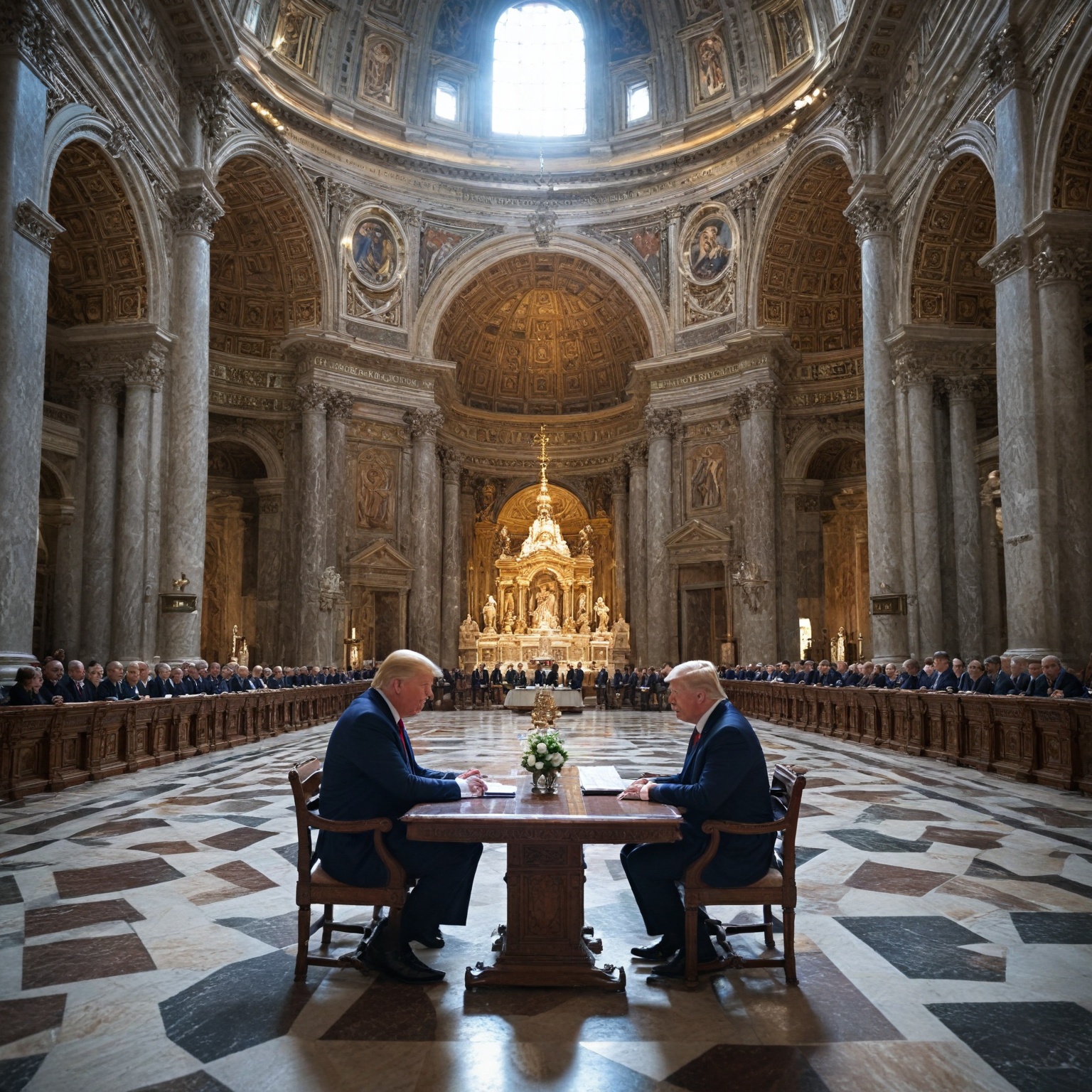
Highlights:
– The contrast between the public Oval Office meeting and the private Vatican meeting between President Trump and President Zelenskyy showcases a shift from tense confrontation to potentially more productive dialogue, hinting at a recalibration of U.S. policy towards Russia.
– The differing reactions to the meetings, with Russian state media praising Trump's approach while European leaders and Ukrainian analysts expressing concern, highlight the complex geopolitical dynamics at play in U.S.-Ukraine relations and the ongoing Russia-Ukraine conflict.
– The discussions around U.S. sanctions policy, including the potential for tougher sanctions on Russia and debates about the most effective strategies, underscore the multifaceted efforts to influence Moscow's actions and support Ukrainian sovereignty.
Summary
The April 26, 2025, meeting between U.S. President Donald Trump and Ukrainian President Volodymyr Zelenskyy at St. Peter’s Basilica in Vatican City marked their first encounter since a highly contentious Oval Office meeting earlier that year. The February 28, 2025, Oval Office meeting had been characterized by a public and tense confrontation, with Trump and Vice President JD Vance criticizing Zelenskyy and urging Ukraine to consider territorial concessions, including the permanent loss of Crimea to Russia—a proposal firmly rejected by Zelenskyy. This incident was widely regarded as a significant low point in U.S.-Ukraine relations, intensifying diplomatic strains amid the ongoing Russia-Ukraine conflict.
In contrast, the Vatican meeting represented a more private and reportedly productive dialogue, occurring at a critical juncture as negotiations aimed at ending the Russia-Ukraine war continued. Trump signaled a willingness to impose tougher sanctions on Russia if peace efforts faltered, threatening large-scale economic measures modeled after sanctions previously used against Iran. This stance suggested a potential recalibration of U.S. policy toward Russia, balancing pressures for conflict resolution with sustained support for Ukraine.
The broader context of the meetings reflects complex dynamics in U.S. sanctions policy. While the Biden administration had implemented comprehensive sanctions under Executive Order 14024, the Trump administration considered both the introduction of harsher penalties and selective easing of sanctions on certain Russian entities as part of possible diplomatic negotiations. These shifts underscored ongoing debates within the U.S. government about the most effective strategies to influence Moscow’s actions and support Ukrainian sovereignty.
Media and political reactions to the meetings were sharply divided along partisan and geopolitical lines. Russian state media condemned the Oval Office confrontation yet praised Trump’s approach, while European leaders and Ukrainian analysts expressed concern over the deterioration of bilateral relations. In the United States, Republicans largely supported Trump’s hardline stance, whereas Democrats criticized the undermining of established commitments to Ukraine’s security. The April Vatican encounter thus stands as a pivotal moment reflecting both the volatility and significance of U.S.-Ukraine relations amid the broader international response to the ongoing conflict.
Background
The meeting between U.S. President Donald Trump and Ukrainian President Volodymyr Zelenskyy on April 26, 2025, marked their first encounter since a highly contentious Oval Office meeting earlier that year. The February meeting had been fraught with tension, with Trump and Vice President JD Vance publicly berating Zelenskyy in front of journalists from conservative media outlets. This confrontational exchange was widely seen as a low point in Ukraine–U.S. relations, with some experts describing it as the “worst moment in UA-US bilateral relations since its inception” due to the perceived disregard of Ukrainian interests during the discussion.
During the February meeting, Zelenskyy, arriving in his traditional wartime fatigues, was criticized by Trump, who made remarks about his attire that reflected broader conservative criticisms of the Ukrainian leader. The exchange quickly escalated into a heated argument over the Russia-Ukraine war, with Trump pushing the idea that Kyiv might need to make territorial concessions, including the permanent loss of Crimea to Russia—a stance that Zelenskyy refused to accept and which reportedly offended Trump.
Despite the discord, the U.S. and its allies continued to impose thousands of sanctions on Russia in response to its invasion of Ukraine, aiming to weaken Moscow’s war capabilities. While the Biden administration had implemented strong sanctions under Executive Order 14024, based on national emergency powers, the Trump administration’s approach hinted at a possible easing of restrictions alongside threats of new measures to accelerate conflict resolution.
The tense Oval Office encounter contrasted sharply with the more intimate setting of the subsequent Vatican meeting, which came at a critical moment as negotiations to end the Russia-Ukraine conflict were ongoing. Analysts noted that the earlier public rebuke in the White House had complicated diplomatic relations, while the Vatican meeting signaled a cautious effort to find common ground. Throughout this period, Zelenskyy emphasized the importance of continued U.S. support and security assistance, despite pressures for compromise on Ukrainian sovereignty.
Proposal of Tougher Sanctions on Russia
The legal framework underpinning most U.S. sanctions on Russia is primarily based on two laws enacted in 1976 and 1977. The 1977 law, which grants the president authority to impose restrictions during a declared “national emergency,” served as the foundation for President Joe Biden’s Executive Order 14024 issued on April 15, 2021. This order enabled the imposition of the most consequential sanctions on Russia and included provisions for secondary sanctions targeting foreign individuals and companies that conduct business with Russian entities.
Amid ongoing tensions, discussions within the U.S. administration have emerged regarding the potential introduction of even tougher sanctions against Russia. Sources indicate that sanctions offices are preparing proposals for lifting sanctions on select Russian entities and oligarchs, reflecting a nuanced approach toward sanction management. However, this also underscores a willingness within previous administrations, notably under President Donald Trump, to ease certain sanctions as part of possible diplomatic deals with Moscow.
President Trump has communicated a clear ultimatum: either Russia and Ukraine negotiate a peace agreement, or the United States will implement stronger economic measures modeled after past sanctions on Iran. Such sanctions would likely target Russian financial institutions and foreign companies engaged with the regime, aiming to exert maximum economic pressure. This stance aligns with calls from some U.S. lawmakers emphasizing the necessity of sustained American support for Ukraine while maintaining firm commitments to international security agreements.
The evolving landscape of U.S. sanctions against Russia remains closely watched by international market participants, as future regulatory developments could significantly impact global diplomatic and economic relations.
April 26, 2025 Meeting with Volodymyr Zelenskyy
On April 26, 2025, President Donald Trump met privately with Ukrainian President Volodymyr Zelenskyy at St. Peter’s Basilica in Vatican City, marking their first encounter since a tense and confrontational meeting in the Oval Office earlier that year. The Vatican meeting occurred amid ongoing efforts to negotiate an end to the conflict between Ukraine and Russia, drawing significant international attention due to its geopolitical implications.
The White House described the discussion as “a very productive discussion,” with both leaders engaging in a one-on-one meeting at the historic site. The encounter came at a critical time when the Trump administration was signaling a potential shift in its stance towards Russia, including the prospect of imposing tougher sanctions if progress toward peace was not achieved.
This meeting followed a period of heightened diplomatic strain after the February 28, 2025 Oval Office incident, where an intense exchange between Trump and Zelenskyy was publicly noted as one of the worst moments in U.S.-Ukraine relations, with the confrontation witnessed by media and analyzed by political observers and body language experts alike. Despite the prior discord, the Vatican meeting suggested an attempt by both sides to recalibrate and engage constructively on critical issues such as security assistance and mineral resource negotiations.
Following the April meeting, the Trump administration maintained a firm position on sanctions, threatening tougher measures modeled after previous restrictions on Iran, aimed at pressuring Russia and accelerating negotiations. Trump publicly expressed frustration with the ongoing conflict, emphasizing the need for decisive action through economic tools like secondary sanctions and banking restrictions. The interaction at the Vatican was perceived as a pivotal moment that could influence the trajectory of U.S.-Ukraine relations and the broader international response to the Russia-Ukraine war.
Political and Diplomatic Implications
The February 28, 2025, Oval Office meeting between U.S. President Donald Trump and Ukrainian President Volodymyr Zelenskyy marked a significant moment in the political and diplomatic landscape surrounding the Russia-Ukraine conflict. The encounter, highly contentious and televised live, was expected to culminate in the signing of the Ukraine–United States Mineral Resources Agreement but ended abruptly without resolution, reflecting deep fissures in bilateral relations and broader geopolitical tensions.
Domestically within the United States, the meeting revealed stark partisan divides. Republican members generally praised Trump’s approach, viewing his pressure on Ukraine to negotiate a peace deal and his mineral rights proposal as strategic moves to end the war. Conversely, Democrats widely condemned the conduct and outcome of the meeting, expressing concern over the apparent suspension of intelligence and military aid to Ukraine that followed the encounter. This suspension was perceived as contradicting longstanding U.S. commitments to Ukrainian security dating back to agreements since 1994 and the 2024 security agreement, prompting criticism from moderate Republicans as well.
From the Ukrainian perspective, the meeting was described as a low point in bilateral relations. Analysts like Mykola Bilieskov of the Ukrainian National Institute for Strategic Studies characterized the interaction as the “worst moment” in U.S.-Ukraine relations since their inception, emphasizing the frustration over Ukraine’s interests being disregarded in real time during the Oval Office exchange. Zelenskyy’s refusal to recognize Crimea under Russian control—a key element of Trump’s peace proposal—highlighted fundamental disagreements that impeded progress toward a ceasefire or settlement.
Internationally, the meeting influenced perceptions and alignments among key stakeholders. European leaders, including British Prime Minister Keir Starmer, expressed support for Zelenskyy and endorsed ongoing efforts toward a ceasefire involving Britain and France. In stark contrast, Russian officials and state media praised the meeting’s outcome, framing it as a diplomatic victory and criticizing Zelenskyy’s stance. Russian commentators described the meeting as unprecedented in its breakdown of diplomatic decorum, with assertions that further military aid to Ukraine was effectively halted.
The meeting also underscored the complexity of U.S. sanctions policy toward Russia. While Trump publicly threatened “large scale” sanctions on Russia to coerce a peace settlement, his administration’s actions appeared inconsistent, as reports indicated ongoing discussions about potential sanctions relief for select Russian entities and oligarchs as part of broader negotiations. This approach diverged from the previous Biden administration’s extensive sanction regime, which Trump had extended but simultaneously sought to soften. The possibility of a renewed dialogue with Moscow and an emphasis on peace talks signaled a shift toward rapprochement, though skepticism remained regarding the feasibility and sincerity of these efforts given the unresolved conflict dynamics.
Media Coverage and Public Perception
Media reactions to the April 26, 2025, meeting between President Donald Trump and Ukrainian President Volodymyr Zelenskyy were deeply polarized, reflecting broader geopolitical and partisan divides. Russian state media expressed shock at the diplomatic breakdown yet praised Trump’s conduct during the encounter. For instance, Alexander Kareevsky, a Russian news anchor, described the meeting as having “stopped observing the limits of decency,” claiming no similar episode existed in diplomatic history. Meanwhile, Margarita Simonyan, head of RT, remarked that “the Oval Office has seen a lot, but never this,” underscoring the unprecedented nature of the interaction from their perspective. Russian coverage also conveyed a dismissive tone towards Zelenskyy, suggesting the Ukrainian president left the meeting “with nothing” and that no future arms deliveries to Ukraine could be expected.
In contrast, European institutions expressed strong support for Ukraine and its leader. Council of Europe Secretary General Alain Berset affirmed, “Ukrainians can count on Strasbourg,” while a joint statement from the European Commission President Ursula von der Leyen, European Council President António Costa, and European Parliament President Roberta Metsola praised Zelenskyy’s “dignity and bravery.” They reaffirmed the European Union’s unwavering commitment to Ukraine’s sovereignty and territorial integrity, emphasizing justice and accountability for crimes committed since 2014 as prerequisites for sustainable peace.
In the United States, public perception and political commentary largely followed partisan lines. Republican members of Congress and conservative media outlets generally commended Trump’s approach to the meeting, interpreting it as a firm stance on Russia and Ukraine policy. However, there were exceptions within the party; for example, Rep. Don Bacon (R-Nebraska) issued a statement implicitly critical of Trump’s conduct, signaling some moderate dissent. Democratic politicians and commentators, on the other hand, widely condemned Trump’s behavior, viewing it as damaging to U.S.-Ukraine relations and undermining America’s commitments to Ukrainian security.
The intimate and symbolic setting of the meeting—held privately at St. Peter’s Basilica in Vatican City—stood in stark contrast to the chaotic and confrontational Oval Office meeting that occurred months earlier. The Vatican meeting attracted considerable international attention due to its potential implications for diplomatic relations and regional stability in Eastern Europe, influencing market sentiments and discussions around regulatory environments, including those concerning international cryptocurrency adoption.
Aftermath and Follow-up Developments
The meeting between President Donald Trump and Ukrainian President Volodymyr Zelenskyy at the Vatican on April 26, 2025, marked their first encounter since a contentious exchange in the Oval Office earlier that year, drawing significant international attention and prompting varied reactions from political actors and media outlets. The encounter occurred amid ongoing efforts to negotiate an end to the war between Ukraine and Russia, with both leaders under pressure to find common ground despite deep-seated tensions.
In the immediate aftermath, the U.S. administration signaled a willingness to reconsider its stance on sanctions against Russia. Sanctions offices began drafting proposals to lift restrictions on select Russian oligarchs and entities, reflecting Trump and his advisers’ openness to easing sanctions as part of a potential diplomatic agreement with Moscow. This development suggested a strategic shift from the more stringent measures imposed under previous policies, including those framed by Executive Order 14024, which authorized comprehensive sanctions during the Biden administration.
Reactions to the meeting were mixed. Russian state media condemned the breakdown in diplomatic decorum during the earlier Oval Office confrontation but expressed support for Trump’s approach, highlighting a belief that further military aid to Ukraine was unlikely and that Zelenskyy had gained little from the discussions. Conversely, Ukrainian analysts described the exchange as a nadir in bilateral relations, with concerns raised about the United States’ commitment to Ukraine’s interests under the Trump administration. The incident underscored the fragile nature of the alliance and the complexities inherent in navigating U.S.-Ukraine relations during the conflict.
Following the meeting, Trump reiterated his firm stance on sanctions, warning of the possibility of imposing large-scale banking sanctions and tariffs on Russia if a ceasefire and peace agreement were not achieved. This threat indicated a readiness to escalate economic pressure should diplomatic efforts stall, potentially drawing parallels with past U.S. sanctions regimes, such as those targeting Iran. The message was clear: the continuation of hostilities without a negotiated settlement would trigger stronger punitive measures.
Economic forecasts reflected uncertainty amid these geopolitical developments. While optimistic scenarios anticipated some easing of tensions, risk assessments by financial authorities warned that intensified sanctions and a broader global crisis could lead to significant declines in Russian exports in 2025 and 2026, with decreases potentially reaching up to 33% in monetary terms. This economic vulnerability highlighted the stakes involved in the ongoing conflict and the leverage sanctions could exert.
The broader international community remained engaged, with the United States, Europe, Canada, Japan, and others reaffirming their support for Ukraine and the imposition of sanctions on Russia, emphasizing the view of Russia as the aggressor in the conflict. Meanwhile, discussions about critical mineral partnerships and other economic collaborations between the U.S. and Ukraine were reportedly underway before the deterioration in relations, suggesting that opportunities for cooperation existed alongside the political strife.
The content is provided by Sierra Knightley, Prime Headlines