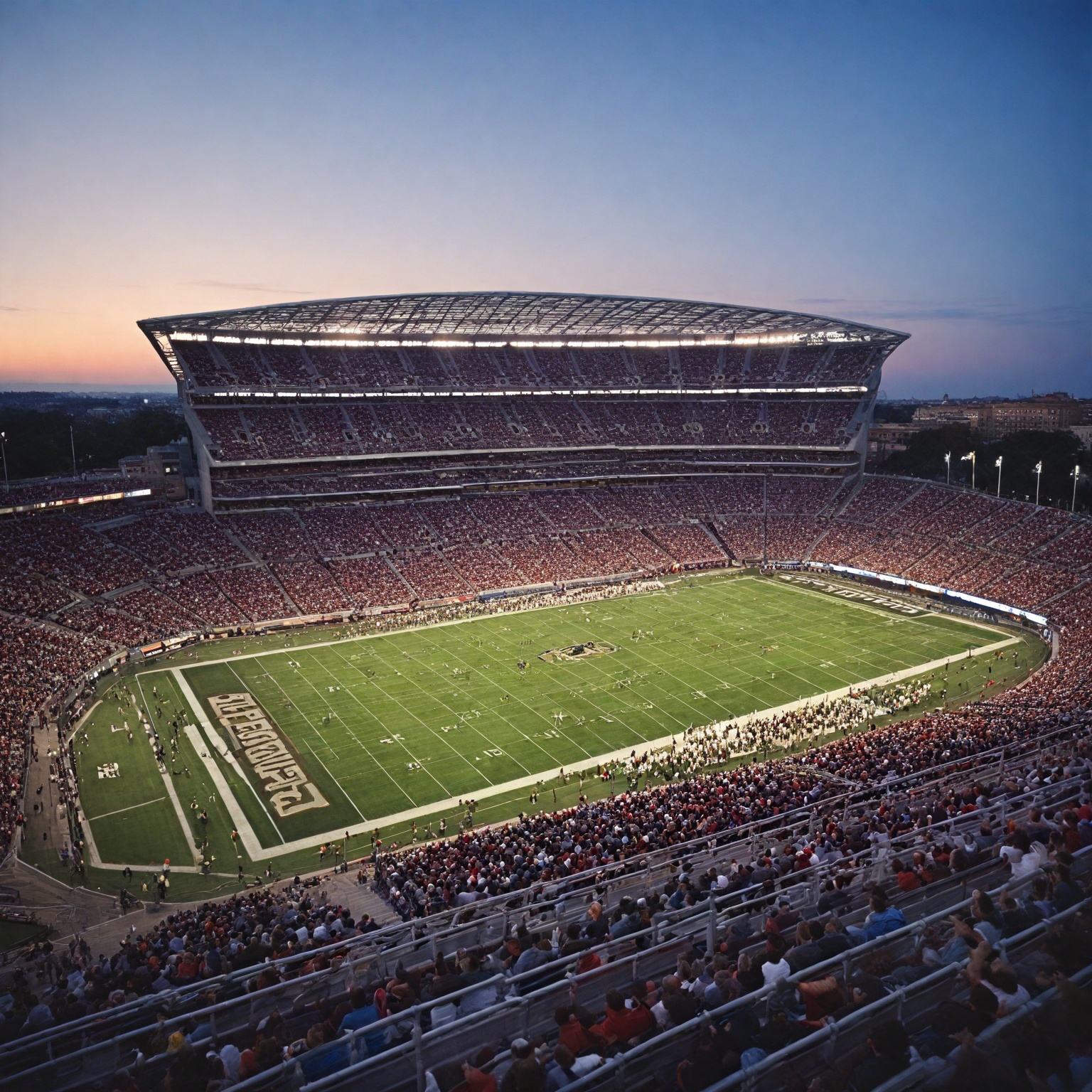
Highlights:
– The $3.7 billion deal to build a new stadium at the historic RFK Memorial Stadium site represents a significant milestone for the Washington Commanders, reconnecting the team to its roots in the nation's capital and promising to revitalize the surrounding area.
– The project, driven by a public-private partnership, is expected to create thousands of jobs, generate substantial tax revenue, and act as a catalyst for urban renewal, positioning the stadium and campus as key contributors to long-term economic growth in Ward 7 and beyond.
– Despite controversy over funding sources, the project aims to engage the community through transparency, local business involvement, and affordable housing provisions, underscoring efforts to ensure equitable benefits and community support amidst the ambitious redevelopment plans.
Summary
The Washington Commanders’ return to Washington, D.C., marks a significant milestone in the franchise’s history, anchored by a landmark $3.7 billion stadium and redevelopment deal announced in April 2024. After more than two decades playing in Landover, Maryland, the team plans to build a new, state-of-the-art 65,000-seat stadium with a retractable roof on the historic site of Robert F. Kennedy (RFK) Memorial Stadium, reconnecting the franchise with its roots in the nation’s capital. The redevelopment will also include a mixed-use waterfront district featuring housing, dining, entertainment, and parkland, aiming to revitalize a long-underutilized area along the Anacostia River and stimulate economic growth in Ward 7.
The deal, shaped by the 2025 D.C. Robert F. Kennedy Memorial Stadium Campus Revitalization Act, represents a public-private partnership in which the Commanders will contribute approximately $2.7 billion toward stadium construction, while the District of Columbia commits around $1.1 billion to infrastructure and surrounding development. Officials project the project will generate 14,000 construction jobs, sustain 2,000 permanent jobs, and produce billions in tax revenue and economic activity over 30 years, positioning the stadium and campus as a catalyst for long-term urban renewal.
While widely hailed for its potential to restore the team’s presence in D.C. and enhance the regional sports and entertainment landscape, the project has sparked controversy over the use of public funds and the balance of federal versus local authority in decision-making. Critics, including some D.C. Council members, caution against allocating taxpayer money toward stadium costs, emphasizing the need for transparency and equitable community benefits amid the ambitious redevelopment plans. Community engagement efforts have been incorporated to address these concerns, focusing on local business participation and affordable housing provisions within the development.
Scheduled to open in 2030, the new stadium is envisioned as a modern venue designed to host a variety of events year-round, featuring fan experience upgrades and enhanced accessibility. The return to D.C. not only honors the Commanders’ legacy—highlighted by three Super Bowl victories during their previous tenure at RFK Stadium—but also signals a new chapter for the franchise and the city’s ongoing efforts to foster economic and social revitalization.
Background
The Washington Commanders have a longstanding history in Washington, D.C., having played at Robert F. Kennedy (RFK) Memorial Stadium from 1961 to 1996 before relocating to Northwest Stadium (formerly FedEx Field) in Landover, Maryland, where they have played since 1997. During their tenure at RFK Stadium, the franchise experienced a golden era, winning three Super Bowls between 1982 and 1991 and making five appearances in the championship game, solidifying the team’s legacy in the city.
Efforts to bring the team back to D.C. gained momentum in recent years, driven in part by new ownership under billionaire Josh Harris and renewed enthusiasm surrounding the franchise’s future. The Commanders’ lease at the Maryland stadium extends through 2027, but plans have been underway to develop a new stadium and surrounding waterfront district on the site of the now-demolished RFK Stadium, a move aimed at reconnecting the team with its historical roots in the city.
Key to enabling this redevelopment was the passage of the D.C. Robert F. Kennedy Memorial Stadium Campus Revitalization Act, signed into law in January 2025. This legislation granted the District government authority to develop the 170-acre federally owned RFK campus for mixed uses, including a requirement that 30% of the land be reserved for parks and open space along the Anacostia River. This lifted previous restrictions that had hampered progress on revitalizing the site and paved the way for a landmark $3.7 billion deal announced in April 2024 between the Commanders and the District of Columbia.
The proposed development includes a transparent-roofed, approximately 70,000-seat stadium with views of the U.S. Capitol, alongside plans for housing, dining, entertainment, and recreation in a waterfront district reminiscent of The Wharf. The project is viewed by local leaders as a critical opportunity for economic growth and urban renewal, transforming a long-underutilized area into a vibrant community hub. While the stadium construction is slated for completion by the 2030 season, the initiative represents a broader commitment to restoring the team’s presence and legacy in the nation’s capital.
Stadium Deal Overview
The Washington Commanders announced a landmark deal to return to Washington, D.C., with plans to build a new, state-of-the-art stadium on the site of the historic Robert F. Kennedy (RFK) Memorial Stadium. The agreement, valued at approximately $3.7 billion, marks a significant milestone in the franchise’s history, bringing the team back to its namesake city after playing in Landover, Maryland, since 1997.
The new stadium will feature a 65,000-seat capacity with a retractable roof designed for year-round use, enhancing the fan experience and supporting a variety of live events beyond football games. The design includes modern amenities such as improved food and beverage services with new market concepts and drink lanes to expedite service and allow fans to return quickly to their seats, alongside substantial investments to upgrade sound quality throughout the venue.
Financially, the Commanders are expected to contribute approximately $2.7 billion toward construction costs, while the District of Columbia will invest roughly $1.1 billion in infrastructure improvements, including parking, utilities, and the development of a surrounding entertainment district comprising housing, dining, recreation, and a sportsplex. The city’s funding aims to support the entire 180-acre campus, fostering economic growth and job creation with an anticipated 2,000 permanent jobs and generating over $4 billion in tax revenue and $15.6 billion in direct spending over 30 years.
The redevelopment project, backed by bipartisan support in Congress and local government, also represents an opportunity to revitalize a long-underutilized area of the city. D.C. Mayor Muriel Bowser emphasized that the deal would catalyze economic development while honoring the legacy of RFK Stadium, which hosted memorable moments in Washington’s sports history, including three Super Bowl victories during the 1980s and early 1990s.
While negotiations continue and final approvals by the D.C. Council are pending, team and city officials expressed confidence that the project would move forward, describing the stadium as a crucial step toward reestablishing the Commanders as a central figure in Washington’s sports and cultural landscape. The stadium is slated to open in 2030, heralding a new era for the franchise and the region.
Stadium Features
The new stadium for the Washington Commanders is planned to open in 2030 on the historic site of the Robert F. Kennedy (RFK) Memorial Stadium along the Anacostia River in Washington, D.C. Designed to seat approximately 65,000 fans, the stadium will feature a roof, enabling year-round use for sporting events and other activities regardless of weather conditions. A conceptual design envisions a futuristic structure with a transparent dome offering views of iconic landmarks such as the U.S. Capitol, creating a visually striking connection between the stadium and the city.
In addition to the stadium itself, the redevelopment project includes a surrounding entertainment district with riverfront housing, dining options, retail shops, and parkland, aimed at creating a vibrant waterfront destination comparable to The Wharf. The entire campus is expected to generate around 2,000 permanent jobs, produce $4 billion in tax revenue, and contribute more than $15.6 billion in direct spending over 30 years.
The stadium will incorporate several modern fan experience enhancements, including upgraded food and beverage services with new market concepts and drink lanes designed to expedite service and reduce time away from seats. Improvements will also be made to premium seating and suite experiences, as well as sound quality throughout the venue. Structural upgrades are planned for elevators, escalators, water and mechanical systems, and other infrastructure to ensure safety and comfort.
Accessibility remains a priority, with multiple Guest Services booths and provisions for fans requiring assistance. The Commanders provide accessible seating and parking options, though availability is limited and fans are encouraged to arrange accommodations in advance. Policies are in place to ensure safety and convenience, including wristbands for young children and restrictions on bag sizes in line with NFL guidelines.
The project is a collaboration between the Commanders’ ownership and the District of Columbia, with a total investment of approximately $3.7 billion, including substantial infrastructure improvements for parking, transportation, and utilities to support the larger redevelopment vision for the 170-acre site. This initiative aims not only to honor the legacy of RFK Stadium, where the franchise achieved significant success, but also to revitalize Ward 7 by providing an anchor development that fosters economic growth and community engagement.
Planning, Approval, and Community Engagement
Planning for the Washington Commanders’ return to Washington, D.C., and the construction of a new stadium at the RFK Stadium site has involved extensive collaboration between the team, city officials, and the community. After nearly a decade of advocacy by Mayor Muriel Bowser, Congress passed the D.C. Robert F. Kennedy Memorial Stadium Campus Revitalization Act in December 2024, which granted the District long-term planning authority over the federally owned RFK campus. The legislation, signed into law in January 2025, lifted previous leasing restrictions and mandated that 30% of the 177-acre site be reserved for parks and open space, excluding a 32-acre riparian area along the Anacostia River.
Since early 2025, the Washington Commanders and District officials have held weekly meetings to develop a master plan for the campus redevelopment and to explore public financing options for the stadium project. The plan encompasses a 65,000-seat, roofed stadium scheduled to open in 2030, alongside mixed-use developments including restaurants, entertainment venues, hotels, and 5,000 to 6,000 new housing units with at least 30% designated as affordable housing. The Bowser administration has emphasized that much of the city’s financial commitment, approximately $1.1 billion, will focus on infrastructure improvements supporting the entire development rather than solely the stadium, with the team contributing about $2.7 billion toward stadium construction.
Community engagement has been an integral part of the planning process. The District’s planning effort includes incorporating the development parcels into the DC 2050 Comprehensive Plan update and conducting a Request for Proposal (RFP) process prioritizing local businesses in the Kingman Park District. Residents and community members have been invited to provide input on the types of uses that would best serve the neighborhood and broader community interests. To address concerns about the use of public funds, some city officials, including Council Chairman Phil Mendelson, have expressed caution regarding the treasury’s financial involvement, arguing that city investments should focus on site infrastructure and broader economic development rather than stadium costs alone.
Financial mechanisms to support the project include a $175 million revenue bond aimed at parking development, funded through in-stadium activities, and an additional $181 million commitment from Events DC for parking garages near community recreation facilities, which Events DC will own. The project has garnered bipartisan support at the federal level, reflecting widespread recognition of the economic and social benefits expected from redeveloping the long-underutilized site.
Economic and Social Impact
The planned return of the Washington Commanders to Washington, D.C., accompanied by a more than $3 billion stadium development at the RFK Stadium site, is expected to generate significant economic and social benefits for the city and its residents. The deal, nearing finalization, involves the Commanders funding the majority of the stadium construction costs, while the District’s investment focuses on infrastructure improvements that will support the entire 180-acre development area.
This redevelopment opportunity arose from bipartisan congressional action granting D.C. control over the federally owned RFK property, allowing the city to pursue long-term planning and development. The project envisions a mixed-use campus including housing, dining, recreation, and an entertainment district along the Anacostia River, aiming to revitalize an area that Mayor Muriel Bowser described as “blighted and underutilized for too long”.
From an economic perspective, the stadium and surrounding development are projected to be a catalyst for job creation and increased tax revenue. The construction phase alone is expected to generate approximately 14,000 jobs, while the completed development anticipates sustaining around 2,000 permanent positions. Furthermore, the project is estimated to produce roughly $4 billion in total tax revenue and over $15.6 billion in direct spending in the region over a 30-year period. This infusion of economic activity is seen as a major boost amid a shifting local economy affected by federal-level decisions, as noted by D.C. officials.
Community involvement has been emphasized in the planning process, with opportunities for local residents and businesses to provide input on the types of uses that would best serve neighborhood needs, particularly within the Kingman Park District. The District’s request for proposals process will prioritize local businesses, promoting inclusive economic growth.
Socially, the development aims to enhance the fan experience and broader community amenities. The new stadium is designed with features such as a glass roof, year-round usability, and improved access to public transit and parking. The project also aspires to elevate the status of the franchise and region by creating a venue capable of hosting major events, including the Super Bowl, which NFL Commissioner Roger Goodell noted would be more likely with the new stadium in place.
While some local leaders have expressed concern about public funds contributing to the project, the mayor’s office maintains that district investments are directed towards infrastructure and broader neighborhood improvements rather than the stadium alone. This distinction highlights the intent to create a development that extends benefits beyond sports, encompassing housing, jobs, recreation, and long-term economic revitalization.
In addition to economic and infrastructural benefits, the Washington Commanders organization continues to demonstrate a commitment to community engagement through their foundation, which focuses on positively impacting children in need and supporting accessibility efforts for fans attending games. The redevelopment thus represents not only an economic opportunity but also a platform for strengthening social ties and community support within Washington, D.C..
Project Timeline
Discussions between the Washington Commanders and District of Columbia officials regarding the redevelopment of the RFK Stadium site began in early 2024, with weekly meetings focused on formulating a master plan for the 177-acre area and assessing public financing options for a new stadium. The project envisions a comprehensive redevelopment roughly the size of four District Wharfs, including a new 65,000-seat stadium with a roof, slated to open in 2030.
On April 28, 2024, Commanders principal owner Josh Harris announced a $3.7 billion agreement to redevelop the RFK Stadium site, marking a significant milestone in the project timeline. The plan anticipates beginning construction in 2025, aiming to have the stadium ready for the 2030 NFL season. This timeline is contingent upon the D.C. Council’s approval of the deal by July 2024, with the possibility of amendments from lawmakers before finalization.
The deal, valued at nearly $4 billion, involves the Commanders contributing approximately $2.7 billion toward stadium construction, while the city commits around $1.1 billion over eight years to infrastructure improvements and broader redevelopment efforts including housing and recreational facilities within the 180-acre development zone. Mayor Muriel Bowser emphasized the urgency and significance of the project, highlighting the transformation of the long underutilized RFK site into a vibrant hub for sports, entertainment, housing, and economic growth along the Anacostia River.
Following the announcement, team officials, including Team President Jason Wright, expressed optimism about the stadium enhancing the fan experience and bringing diverse live events to the D.C. metropolitan area. The joint news conference featuring Mayor Bowser, Josh Harris, and NFL Commissioner Roger Goodell symbolized a shared commitment to advancing a project that serves
Challenges and Considerations
The Washington Commanders’ nearly $4 billion stadium and redevelopment deal at the RFK Stadium site has faced several challenges and raised numerous considerations related to funding, local governance, environmental impact, and community concerns. One significant issue involves the role of federal and local authorities in decision-making. Councilmember McDuffie highlighted that many economic impacts are due to federal decisions rather than local government actions, underscoring complexities in jurisdictional control over the project. Additionally, Council Chairman Phil Mendelson expressed opposition to using the District’s treasury funds to finance the stadium, emphasizing that local resources should not be allocated toward stadium costs. The mayor’s office, however, has argued that investments in infrastructure upgrades supporting broader residential, commercial, and retail development justify the expenditure beyond just the stadium itself.
Environmental and procedural hurdles have also slowed progress. Although asbestos removal and seat dismantling at the old RFK Stadium were completed, demolition stalled while the National Park Service conducted environmental assessments, including the issuance of a Finding of No Significant Impact (FONSI), which is critical before moving forward with demolition efforts. This delay reflects the careful balancing act between redevelopment ambitions and environmental stewardship.
Financially, the arrangement requires careful approval by the D.C. Council, as the city plans to invest approximately $1.1 billion toward infrastructure, roads, and other development surrounding the stadium. This public investment is intended to complement the Commanders’ $2.7 billion commitment, but it has attracted scrutiny given the substantial taxpayer involvement in the project. The deal also anticipates generating around 14,000 construction jobs and 2,000 permanent jobs, with expected tax revenues reaching $4 billion and direct spending exceeding $15.6 billion over 30 years, factors that proponents argue justify the public expenditure.
Accessibility and fan experience considerations remain a focus as well. The Commanders continue to implement upgrades to FedExField to improve entry, seating, and amenities while planning for a fully modernized stadium in 2030. Attention to accessibility includes accommodations for fans with disabilities, dietary restrictions, and security protocols aimed at enhancing overall visitor satisfaction.
Controversies and Criticisms
The Washington Commanders’ $3.7 billion stadium deal in Washington, D.C., has sparked significant controversy and criticism from various stakeholders. One key point of contention is the involvement of public funds in the project. While the Commanders are expected to contribute up to $2.5 billion, the District of Columbia plans to provide up to $850 million toward eligible capital costs related to the stadium and surrounding infrastructure, including parking structures. This allocation of taxpayer money has drawn criticism from local officials such as Council Chairman Phil Mendelson, who argued that “the D.C. treasury should not be paying toward a stadium”. Mendelson and others express concern that public funds may disproportionately benefit a professional sports franchise rather than the broader community.
Another area of debate centers around the federal and local government roles in the project. Some officials, like Councilmember Kenyan McDuffie, emphasized that many challenges faced during negotiations are “of no fault of local District of Columbia government” but result from decisions made at the federal level that affect the local economy. The transition of control over the RFK Stadium campus from federal to District authority—achieved through the 2024 D.C. Robert F. Kennedy Memorial Stadium Campus Revitalization Act—was a critical legislative milestone that enabled the deal but also raised questions about long-term urban planning and development priorities.
Community engagement and development transparency have been other focal points of criticism. The project’s ambitious scale—encompassing a 180-acre campus with mixed-use development and a stadium designed to seat approximately 70,000 spectators—has prompted calls for greater public input and oversight to ensure that local businesses and residents benefit from the redevelopment. Although the planning process includes provisions for community involvement and prioritizes local business participation through the District’s request-for-proposal process, some remain skeptical about how equitably these commitments will be fulfilled.
In sum, while the Commanders and city officials tout the project as a catalyst for economic growth and a boon to the city’s sports culture, concerns over public financing, federal versus local authority, and community impact continue to fuel controversy surrounding the stadium deal.
Future Prospects and Legacy
The return of the Washington Commanders to the District of Columbia, anchored by a landmark $3.7 billion redevelopment deal for the RFK Stadium site, marks a transformative chapter for the franchise and the region. Managing Partner Josh Harris emphasized that this new stadium represents a “once-in-a-generation catalyst for uplifting and transforming our region,” underscoring the broader community and economic benefits envisioned beyond football.
The planned development is structured so that the Commanders will cover the majority of the stadium construction costs, while the city’s investment will focus largely on infrastructure improvements supporting the entire 180-acre site. This balance aims to create a lasting urban legacy that serves both the team and the District’s residents for generations to come. The project is expected to generate significant employment opportunities, including approximately 14,000 temporary construction jobs and 2,000 permanent positions, contributing to the local economy.
Since new ownership took over in mid-2023, the Commanders organization has pursued a comprehensive transformation on and off the field. Investments exceeding $75 million have been made to enhance FedExField’s facilities and fan experience, including upgrades to seating, concessions, and stadium infrastructure, reflecting a commitment to elevating the overall game-day environment during the transitional period before the new stadium opens. Team President Jason Wright highlighted these improvements as steps forward for both players and fans, with an eye toward a vibrant future filled with memorable live events beyond football.
The new stadium is also expected to reinvigorate regional pride by bringing the team back to its historical home in D.C., a move that resonates deeply with fans and the broader community. Harris noted the unifying power of Washington football, transcending differences of race and religion, especially during the team’s heyday at RFK Stadium when it won three Super Bowls in the 1980s and early 1990s. The return to the District is seen as a symbolic and practical step toward reestablishing the Commanders as a premier NFL franchise and community institution.
Looking ahead, the new stadium is poised to meet NFL standards for hosting marquee events; Commissioner Roger Goodell indicated that the earliest the Commanders could host a Super Bowl at the new venue would be 2032, assuming a 2030 opening. This milestone would further solidify the team’s legacy and the venue’s status as a premier sports and entertainment destination.
The content is provided by Avery Redwood, Prime Headlines